

Most brands don’t have a marketing problem.
They have a communication problem.
And the worst part?
They don’t even realize it.
They think:
• “We need better creatives”
• “We need to post more”
• “We need to run ads”
But none of these fix the real issue.
Because communication is not about what you post.
It’s about how you are perceived.
What is Brand Communication Strategy?
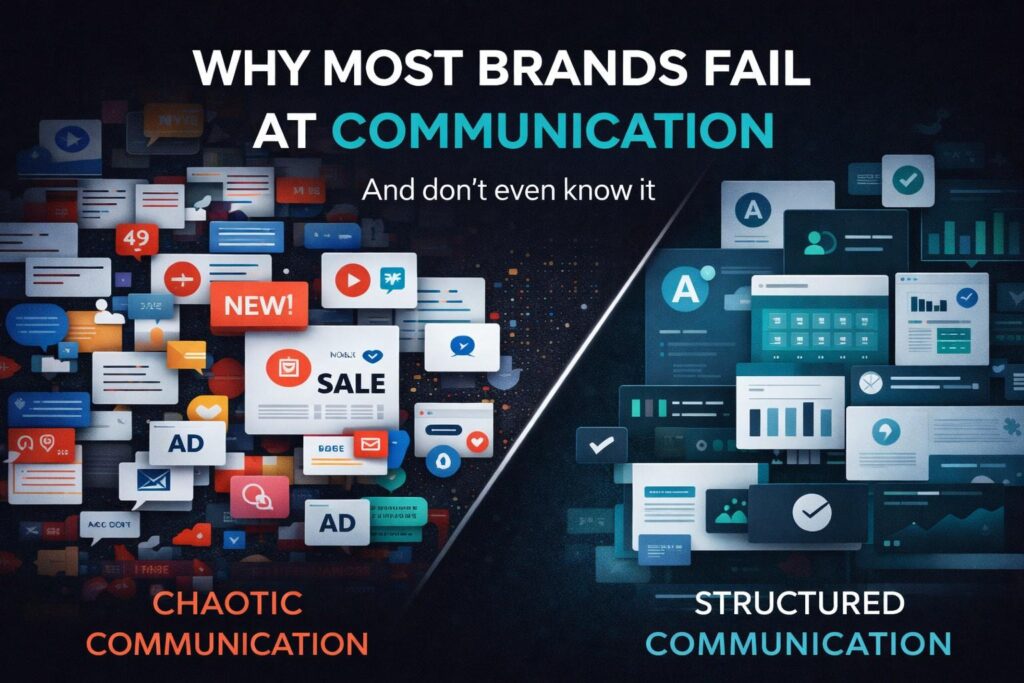
Brand communication strategy is the system that defines how a brand speaks, appears, and behaves across every touchpoint. It aligns messaging, visuals, and narrative so the audience doesn’t just see the brand — they understand it.
Without it, brands produce content. With it, brands build perception.
The Real Problem: Communication Without Structure
Look at most brands today.
They are active.
They are posting.
They are investing.
But still:
• No recall
• No authority
• No consistent identity
Why?
Because their communication is fragmented.
One post says one thing.
Next campaign says something else.
Visuals keep changing.
Tone keeps shifting.
There is no system.
Only activity.
And activity without structure does not build perception.
Visibility ≠ Influence
This is where most brands get it wrong.
They chase:
• reach
• impressions
• followers
But ignore:
• clarity
• consistency
• positioning
You can be visible and still be ignored.
Because influence is not created by frequency.
It is created by clarity of message over time.
The “Content Trap”
Most brands fall into this cycle:
- Post regularly
- Follow trends
- Copy what others are doing
- Try to “stay active”
This creates noise, not communication.
Content without direction becomes:
• repetitive
• forgettable
• disconnected
And over time, the brand starts looking like everyone else.
Communication Is an Environment
Strong brands don’t just “create content”.
They build communication environments.
Everything aligns:
• visuals
• messaging
• tone
• platforms
• execution
When someone interacts with the brand anywhere —
they feel the same clarity.
That’s not coincidence.
That’s design.
The Hidden Layer: Perception Design
Here’s what most people don’t understand:
People don’t remember what you say.
They remember how you made them understand you.
That is perception.
And perception is not accidental.
It is built through:
• repetition
• structure
• visual consistency
• narrative alignment
Without this, even great content fails.
Why Execution Alone Fails
Many brands hire:
• designers
• video editors
• social media managers
But still struggle.
Because execution without direction leads to:
• good-looking content
• zero strategic impact
Execution multiplies strategy.
It cannot replace it.
The Difference Between Active Brands and Powerful Brands
Active brands:
• post regularly
• follow trends
• focus on output
Powerful brands:
• control narrative
• maintain consistency
• build recognition over time
One is busy.
The other is intentional.
What Actually Works
If a brand wants to grow seriously, it must shift from:
👉 content creation
to
👉 communication design
That means:
• defining clear positioning
• building structured content systems
• maintaining visual and narrative consistency
• aligning all communication channels
Growth then becomes a byproduct — not a struggle.
Final Thought
Most brands don’t fail because they lack effort.
They fail because they lack clarity and structure.
And until communication is treated as a system —
not just content — nothing really changes.
If You’re Building Something Serious
Whether it’s a brand, campaign, or institutional presence —
communication is not something you “do”.
It’s something you design.
If you’re looking to build structured, high-impact communication systems that actually shape perception and scale influence: